
Further Media
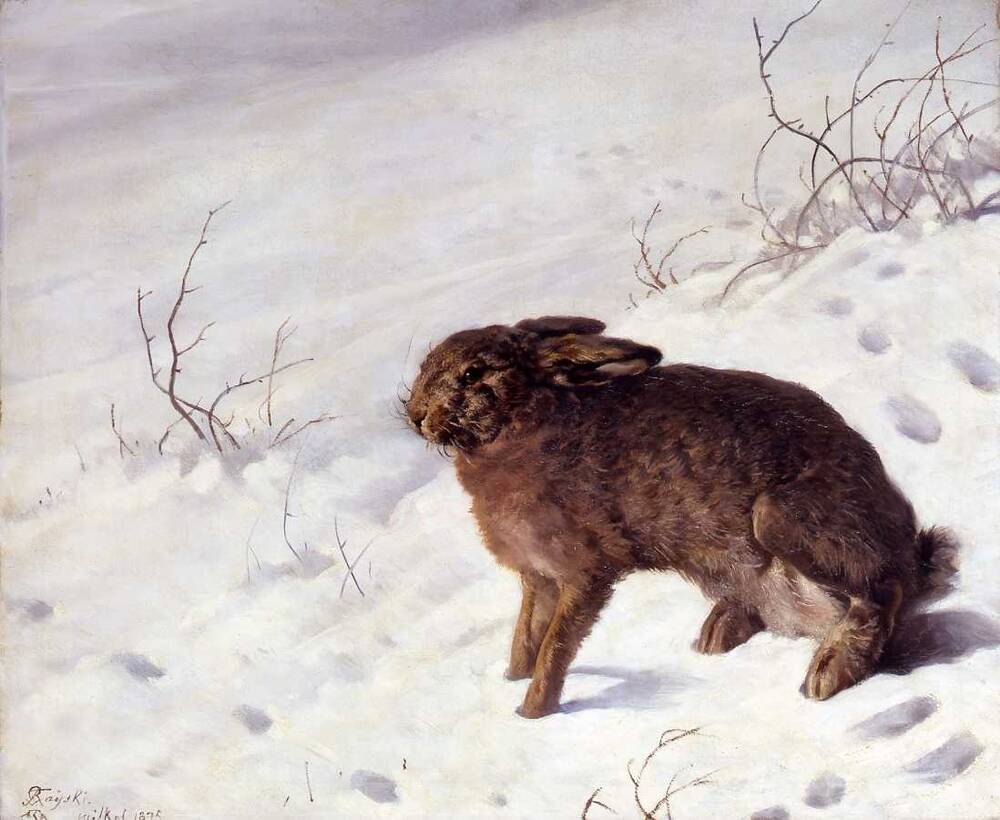
Danger is lurking somewhere nearby. With its ears flat against its body, the hare sniffs the cold winter air, focused intently on its surroundings. Its body is tense, poised to dart away and escape at incredible speed – or be killed by a shot from a gun.
In that sense, this hare has been depicted from both an artist’s and a hunter’s perspective. With many friends among aristocratic families, Ferdinand von Rayski often stayed at their country estates, where he drew, painted and hunted. Here, he renders the hare and its surrounding in meticulous detail. In dry brushstrokes, skilfully executed, he depicts the bare twigs projecting from the snow, while he applies a soft, looser stroke for the hare’s fur swept by gusts of wind. The snow gleams in different shades of colour. In the way he conveys the quality of light and a fleeting moment, Ferdinand von Rayski is regarded as anticipating Impressionism.
Even when focusing on a mimetic copy of outward features, he does not remain just on a surface level. Here, it’s almost as if we hear the animal’s heart beating, comprehend its feelings and grasp – in this one moment – its entire being.
As curator Holger Birkholz says,
"In my view, what’s crucial in Rayski’s animal portraits is that he paid just as much attention to the animal’s individual nature and character as he did to the people he portrayed in his large paintings. In that sense, he approaches the psychology of, say, Chamberlain Count Julius Zech-Burkersroda and the hare in the snow with the same seriousness and attention. That’s very much a distinguishing feature of Rayski and his work – a strong sense of the character of the living creatures he portrayed, whether animal or human."
Nebezpečí číhá blízko. Zajíc s nastraženýma ušima jej větří v chladném zimním vzduchu. Jeho tělo je napnuté, za okamžik vyskočí a začne kličkovat, aby nebezpečí unikl – nebo ho přeci jen trefí kulka.
Je to pohled malíře a lovce, který ho takto zachytil. Ferdinand von Rayski byl častým hostem na venkovských sídlech spřátelených šlechtických rodin, kde kreslil, maloval a účastnil se lovů. Zajíce i jeho okolí reprodukuje mimořádně přesně. S jistotou vedenými, suchými tahy štětce maluje holé křoví vyčnívající ze sněhu. Pro srst zajíce pocuchanou větrem volí měkké, volné tahy a třpytivý sníh zachycuje v různých odstínech. Díky svému způsobu, jakým Ferdinand von Rayski zvýrazňuje světlo a zachycuje určitý okamžik, je považován za jednoho z předchůdců impresionismu.
I když se malíř soustředí na přesnou reprodukci exteriéru, nespokojuje se jen s tímto povrchem. Obraz v nás budí dojem, jako bychom mohli vnímal tlukot zajícova srdce, jeho napnuté smysly v tomto okamžiku, celou jeho bytost. Kurátor Holger Birkholz vysvětluje:
„Myslím, že zásadní v Rayského tvorbě je, že na svých zvířecích obrazech věnuje charakteru jednotlivých zvířat stejnou pozornost jako lidem na svých velkých obrazech. Tím myslím, že zachycuje psychologii komořího Zech-Burkersroda a psychologii zajíce ve sněhu se stejnou pečlivostí a věnuje jim naprosto stejnou pozornost. A to je to, co je pro Rayského velmi typické, tento silný cit pro charakter všech, které portrétuje, ať už jde o zvířata nebo lidi.“
- Location & Dating
- 1875
- Material & Technique
- Oil on canvas
- Dimenions
- 80,5 x 97 cm (Katalogmaß 2010) 80,5 x 97 cm (Inventurmaß, 23.04.2010) 102 x 119,3 x 9,5 cm (Rahmenmaß, Tobias Lange, 23.04.2010)
- Museum
- Galerie Neue Meister
- Inventory number
- Inv.-Nr. 07/03