
Further Media
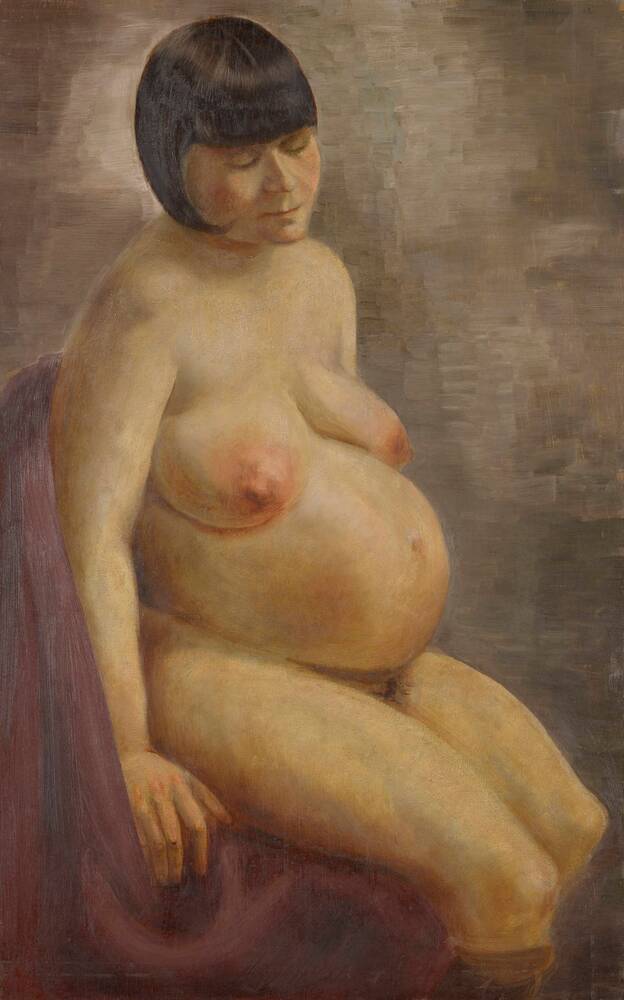
In 1932, when Gussy Hippold-Ahnert painted her Sitting Pregnant Woman, she was a master student under Otto Dix at the Dresden Academy of Art. Dix’s influence is easy to spot in this work, since just like her teacher Hippold-Ahnert is interested in a highly lifelike depiction of reality. She presents a direct, unembellished view of the pregnant women’s body. Dix also taught her how to apply paint as glazes. Prominent in the Old Masters’ canon of classic art, the glaze technique builds up several layers of transparent colour.
Yet this painting also shows how Hippold-Ahnert already had her own artistic vision, even in her early twenties. Despite the realism of the composition, she gives us a very empathetic picture of this pregnant woman. Her eyes are closed, and a faint smile plays around her lips. Absorbed in her own thoughts, she seems quite centred in herself. Otto Dix also took a pregnant woman as his subject, but he was only interested in analysing the physical body in an exceptional state. In his work, the artist’s gaze is anything but empathetic.
It is remarkable how often Dix’s classes were dedicated to painting or sketching pregnant women. At that time in Germany’s Weimar Republic, this was a very topical subject since the political left-wing were fighting abortion’s criminalisation and the drastic punishments for terminating pregnancies under Section 218 of the Penal Code. In particular, unwanted pregnancies were common in working-class milieus, often in families already living under difficult conditions. Although left wing protests against Section 218 did not lead to the law being repealed entirely, the penalties were reduced. Later, though, the Nazi regime reversed the amendment.
When Hitler and the Nazi Party took power in 1933, Hippold-Ahnert’s career ended before it had properly begun. Her paintings were incompatible with the new regime’s idea of art.
Když Gussy Hippold-Ahnertová roku 1932 malovala obraz „Sedící těhotná“, byla ještě žákyní Otto Dixe na drážďanské Akademii umění. Vliv jejího učitele je jasně patrný: Stejně jako Dix se také Hippold-Ahnertová snaží o pokud možno realistické zobrazení a zobrazuje tělo těhotné ženy bez jakýchkoli příkras. Od Dixe se také naučila malovat technikou glazury starých mistrů, během které se transparentní barvy nanášejí v několika vrstvách na sebe.
Obraz však také ukazuje, že se Hippold-Ahnertová již ve svých dvaceti letech snažila motivy zachytit z vlastního pohledu: Přes veškerý realismus maluje těhotnou ženu velmi citlivě – se zavřenýma očima a s lehkým úsměvem na rtech. Je v myšlenkách ponořená do sebe, soustředí se pouze na sebe samu. Také Dix namaloval obraz těhotné ženy. Jeho zajímal ale pouze motiv těla ve výjimečném stavu. Nenajdeme na něm žádnou stopu po empatii.
Těhotné ženy byly v Dixově třídě častým motivem, neboť téma těhotenství bylo v tehdejší době aktuální. Politická levice ve Výmarské republice bojovala proti paragrafu 218, který stanovoval drastické tresty za potraty. Zejména v dělnické třídě docházelo k mnoha nechtěným těhotenstvím – často v rodinách, jejichž životní situace byla již tak jako tak obtížná. Politické levici se podařilo dosáhnout alespoň snížení trestů, tuto změnu zákona však později zvrátili národní socialisté.
Když se Hitler v roce 1933 dostal k moci, skončila kariéra Hippold-Ahnertové dříve, než skutečně začala. Její obrazy nebyly slučitelné s názory nového režimu na výtvarné umění.
- Location & Dating
- 1932
- Material & Technique
- Oil on plywood
- Dimenions
- 95 x 59 cm (Katalogmaß 2010) 94,5 x 59 cm (Inventurmaß, 25.11.2010) 108,2 x 72,5 x 3,5 cm (Rahmenmaß, Tobias Lange, 25.11.2010)
- Museum
- Galerie Neue Meister
- Inventory number
- Inv.-Nr. 80/21