
Further Media
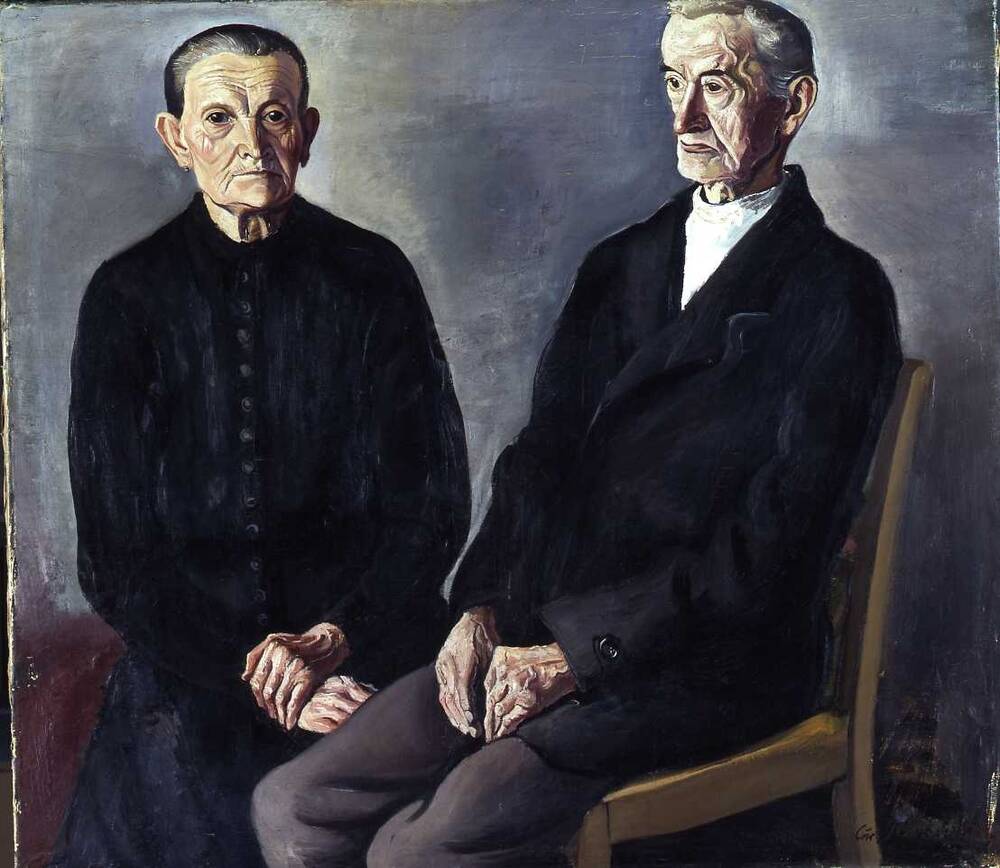
In this double portrait, artist Curt Querner has depicted his parents honestly and affectionately, but without sentimentality – and without all kinds of embellishments to tell us about their ages and their hard lives. In a bare, dispassionate space, his father and mother sit next to each other – upright, composed, yet with a certain distance. They both seem to be caught in their own thoughts. The deep furrows in their faces tell of heavy physical work – as do, even more so, their large hands with prominent veins.
The Querners lived in very modest circumstances in Börnchen, a village south of Dresden. Both the artist’s parents were deaf, and his father earned a living as a shoemaker. Initially, their talented son Curt submitted to his father’s wish to train as a locksmith, but he then insisted on having his own way and studying art. Tradition has it that since he had no money for a train ticket, he had to walk from his home to Dresden’s Academy of Art.
Curt Querner set himself the goal of seeing things clearly, and not being misled by illusions. He wanted to paint good pictures. In a markedly reduced palette, he meticulously executed this double portrait in a fine brush. His artistic inspiration was Otto Dix, who had once painted Querner’s parents as ‘workers’. Their son’s picture of them, though, was more caring. He lent his mother and father a certain dignity and a sense of appreciation.
Initially in the GDR, Curt Querner’s art was not properly recognised, despite his membership of the German Communist Party (KPD) and authentically depicting his environment and milieu. At that time, though, the East German state favoured a positive image of workers, avoiding manual work’s difficulties and hardships. That policy only changed from the 1960s – and then, as Curt Querner later said, museum directors were queuing up to buy his pictures.
Malíř Curt Querner zobrazil své rodiče s velkou upřímností a s láskou, ale bez sentimentu a aniž by se snažil různými detaily zlehčit jejich těžký život a stáří. Otec a matka sedí vedle sebe v jednoduše zařízeném, chladném pokoji – ve vzpřímené a klidné pozici, ale s jistým odstupem. Své pohledy obracejí do svého vnitra a hluboké vrásky na jejich tvářích, ale ještě více velké ruce s vystouplými žilami vypovídají o těžké fyzické práci.
Quernerovi žili v nejprostších poměrech ve vesnici Börnchen jižně od Drážďan. Oba rodiče byli hluší a otec vydělával na živobytí jako švec. Jejich nadaný syn Curt se zpočátku podřídil otcovu přání a vyučil se zámečníkem, ale později prosadil svou vůli stát se umělcem. Na akademii musel chodit z domova do Drážďan pěšky, protože neměl peníze na lístek na vlak.
Curt Querner se snažil vidět věci ostře a nenechat se oklamat iluzemi. Chtěl malovat dobré obrazy. Tento dvojportrét vypracoval jemným štětcem a s velkou pečlivostí, přičemž svou barevnou paletu velmi redukoval. Jeho uměleckým vzorem byl Otto Dix. Také on portrétoval své rodiče jako „dělníky“, ale Quernerův pohled na ně byl na rozdíl od Dixe láskyplný. Namaloval své rodiče s důstojností a s uznáním před jejich životem.
Přestože byl členem Komunistické strany a na svých obrazech autenticky zobrazoval své životní prostředí, nebyl v NDR zpočátku příliš uznáván. Vedení strany chtělo, aby umělci zobrazovali dělnickou třídu pozitivně, ne tvrdě a ošklivě. Teprve v 60tých letech začalo být jeho umění vnímáno jinak a – jak sám později vyprávěl – nyní u něj stáli ředitelé muzeí frontu na jeho obrazy.
- Location & Dating
- 1947
- Material & Technique
- Oil on canvas
- Dimenions
- 121,5 x 137,5 cm (Katalogmaß, BK 2010) 121,5 x 137,5 cm (Inventurmaß, 19.05.2010) 133,2 x 143,2 x 5,2 cm (Rahmenmaß, 19.05.2010)
- Museum
- Galerie Neue Meister
- Inventory number
- Leih-Nr. L 14