
Further Media
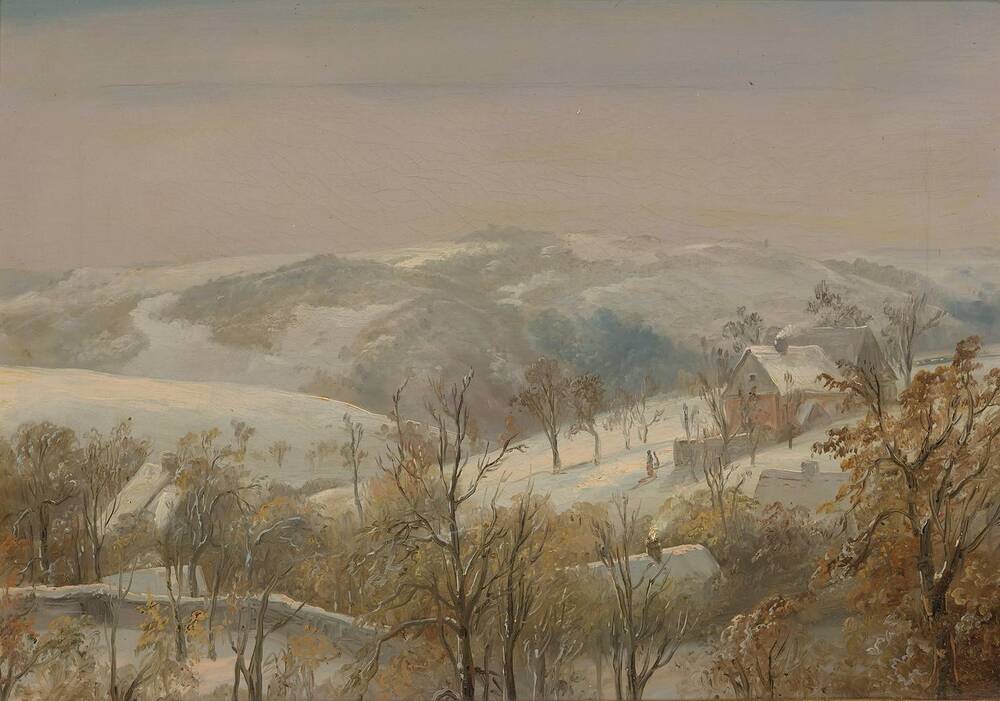
At first glance, this little peaceful winter landscape of the area around Maxen near Dresden seems rather unspectacular – though not when you know more about the artist. Raden Saleh was born in Indonesia, but became part of the circle around the Dresden Romantics.
At that time, present-day Indonesia was a Dutch colony. A clever, talented and ambitious young man, Raden Saleh was well connected to the highest aristocratic circles. Fearing he could endanger the colonial system, the Dutch authorities sent him to the art academy in The Hague where he studied portraiture and landscape painting. Afterwards, as was usual at that time, he embarked on a grand tour of Europe – which included a visit to Dresden. The Lion Hunt by Rubens in Dresden’s Gemäldegalerie inspired Saleh to dedicate himself to this genre, and he painted a series of opulent lion and tiger hunts. During his stay in Dresden from 1839 to 1844, his choice of subjects and his presentation of himself as a Javanese prince attracted considerable attention. However, while still a national figure in Indonesia today, Raden Saleh was forgotten in Dresden.
His teacher Andreas Schelfhout introduced him to the tradition of winter landscapes in Dutch painting. In Dresden, not only had Caspar David Friedrich painted snowy landscapes but also Johann Christian Dahl – whose son was friends with Raden Saleh.
In the late 1840s, Saleh was living in Paris when he heard that Anton Serre, his friend and patron from his Dresden days, had been taken seriously ill. Anton Serre and his wife had withdrawn to their country estate in Maxen and Saleh promptly set out to visit them despite the political unrest sweeping across Europe and also evident in Dresden. In that sense, Saleh’s winter landscape can also be read as a metaphor for a political and social stasis with the hope of the revival of a more liberal life.
Na první pohled se tato malá, tichá zimní krajina v oblasti kolem Maxenu nedaleko Drážďan nezdá být příliš zajímavá. Avšak změníme názor, když se dozvíme, kdo byl malířem tohoto obrazu: Raden Saleh pocházel z Indonésie, ale patřil ke skupině malířů drážďanského romantismu.
Indonésie byla v tehdejší době pod nizozemskou nadvládou. Protože se jeho rodina obávala, že by tento chytrý a ambiciózní mladý muž ze šlechtických kruhů mohl být pro koloniální systém nepohodlný a nebezpečný, poslali ho na uměleckou akademii v Den Haagu, kde studoval portrétní umění a krajinomalbu. Po ukončení studia – jak v té době bylo zvykem – se Saleh vydal na vzdělávací cestu, která ho zavedla mimo jiné také do Drážďan. Rubensův obraz „Lov na lva“ v Galerii starých mistrů ho inspiroval natolik, že se od té doby věnoval především tomuto žánru. Raden Saleh namaloval řadu honosných lovů na lvy a tygry. Ve společnosti se vydával za jávského prince, což mu – společně s tématy jeho obrazů – během jeho pobytu v Drážďanech v letech 1839 až 44 přineslo velkou pozornost. V Indonésii dodnes patří k uznávaným velkým národním osobnostem, ale v Drážďanech upadl do zapomnění.
S tradicí zimních krajin v nizozemském malířství Saleha seznámil jeho učitel Andreas Schelfhout. V Drážďanech maloval zasněžené krajiny Caspar David Friedrich stejně jako Johan Christian Dahl, s jehož synem se Saleh přátelil. Koncem 40. let 19. století – Rahden Saleh tehdy žil v Paříži – vážně onemocněl jeho přítel a mecenáš z drážďanských let: Anton Serre. Přestože v celé Evropě včetně Drážďan panovaly politické nepokoje, vydal se Saleh na cestu do Maxenu, kam se manželé Serreovi uchýlili na své panství. A tak lze jeho obraz „Zimní krajina“ také interpretovat jako metaforu politického a společenského ustrnutí, spojeného s nadějí na svobodomyslný život.
- Location & Dating
- 1848
- Material & Technique
- Oil on canvas
- Dimenions
- 31 x 45 cm
- Museum
- Galerie Neue Meister
- Inventory number
- Leih-Nr. L 497