
Further Media
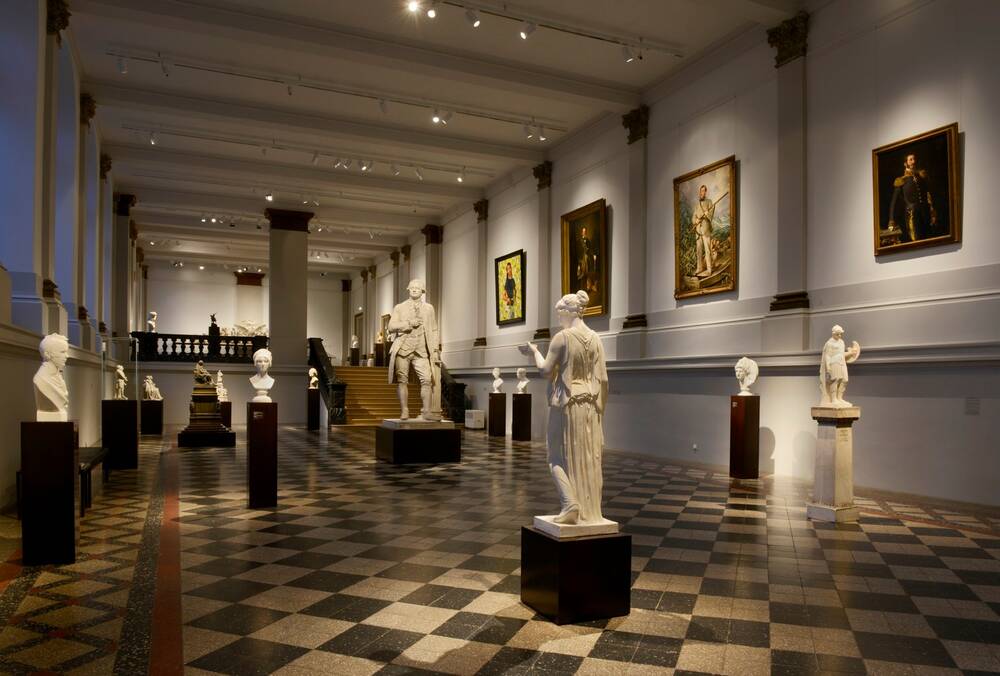
“The Albertinum’s Mosaic Hall is named after a Roman mosaic which can be seen in the upper part of the hall. Here, we are showing art from around 1800 to the mid-nineteenth century, with the spotlight on two artists and their work in particular: on the one hand, Ernst Rietschel, Dresden’s leading nineteenth-century sculptor, and on the other, the painter Ferdinand von Rayski.”
The room’s basic structure has not changed since the 1880s when the building, formerly an arsenal, was converted into a museum. During conversion work, pilaster strips and capitals were added to the walls. A Roman mosaic, discovered in Italy in 1843, also found a new home here. To give the Mosaic Hall a modern, reserved look, it was decorated in various shades of grey during the major refurbishment from 2006 to 2010. Afterwards, the sculptures were moved back into the space. But a few years later, a decision was taken to integrate the large wall spaces into the display as well. This involved initially checking the statics before fitting gallery rails to hang the paintings from the first half of the nineteenth century – with at their centre, quite unexpectedly, a contemporary work: General John Burgoyne by American artist Kehinde Wiley. Holger Birkholz:
“When setting up the room, we realised how the public display of male images played a particular role in the works of both Ernst Rietschel and Ferdinand von Rayski. In other words, they were depicting rulers and figures from the arts world in postures of power – and that was our starting point to find an artistic position allowing us, as it were, to present a differentiated view of the representation of male power in art history. That’s how we arrived at the work of Kehinde Wiley and started a conversation with him, and we’re very glad his painting on show here enables us to make bring out this aspect of art history so visibly.”
„Sál s mozaikami v Albertinu dostal název díky antické mozaice, jak je vidět na empoře. Je zde vystaveno umění první poloviny 19. století. Věnujeme se zde především dvěma uměleckým osobnostem. Na jedné straně to je Ernst Rietschel jako nejvýznamnější sochař 19. století, který působil v Drážďanech. A na straně druhé to je Ferdinand von Rayski, jehož obrazy dominují tuto místnost.“
Základní charakter místnosti se v 80. letech 19. století, kdy byla zbrojnice proměněna v muzeum, nezměnil. Z této doby pocházejí pilastry a hlavice na stěnách, stejně jako římská mozaika, která byla roku 1843 objevena v Itálii a zde našla nové přístřeší. Během rozsáhlé přestavby v letech 2006 až 2010 získal sál s mozaikami díky šedé barvě v různých odstínech nynější moderní, střídmý vzhled. Po přestavbě sem byly nejprve opět přestěhovány sochy. O několik let později bylo rozhodnuto využít i velké plochy stěn. Nejprve bylo nutné zkontrolovat jejich statiku a poté byly na stěnách instalovány závěsné lišty. Nakonec zde mohly být zavěšeny obrazy z první poloviny 19. století. Uprostřed těchto obrazů se překvapivě nachází také jedno dílo současného amerického umělce Kehinde Wiley: „Generál John Burgoyne“. Holger Birkholz:
„Když jsme tuto místnost zařizovali, uvědomili jsme si, že zobrazení mužských postav hraje u obou umělců zvláštní roli: Jedná se o básníky a vládce prezentované v póze moci. Tato skutečnost pro nás byla podnětem k hledání umělecké pozice, která by nám umožnila, chcete-li, diferencovaně nahlížet na reprezentaci mužské moci v dějinách umění. A tak jsme objevili Kehinde Wileyho a navázali s ním kontakt. Jsme velmi rádi, že nám obraz Kehinde Wileyho umožňuje tento aspekt dějin umění jasně zviditelnit.“